


.webp)
Keeping a swimming pool clear is not simply a matter of adding chlorine. The type of chlorine you use can affect sanitation, pH management, cyanuric acid levels, chemical costs, and how much attention your pool needs throughout the week.
That is why the liquid chlorine vs tablets question matters for homeowners who want predictable pool chemistry.
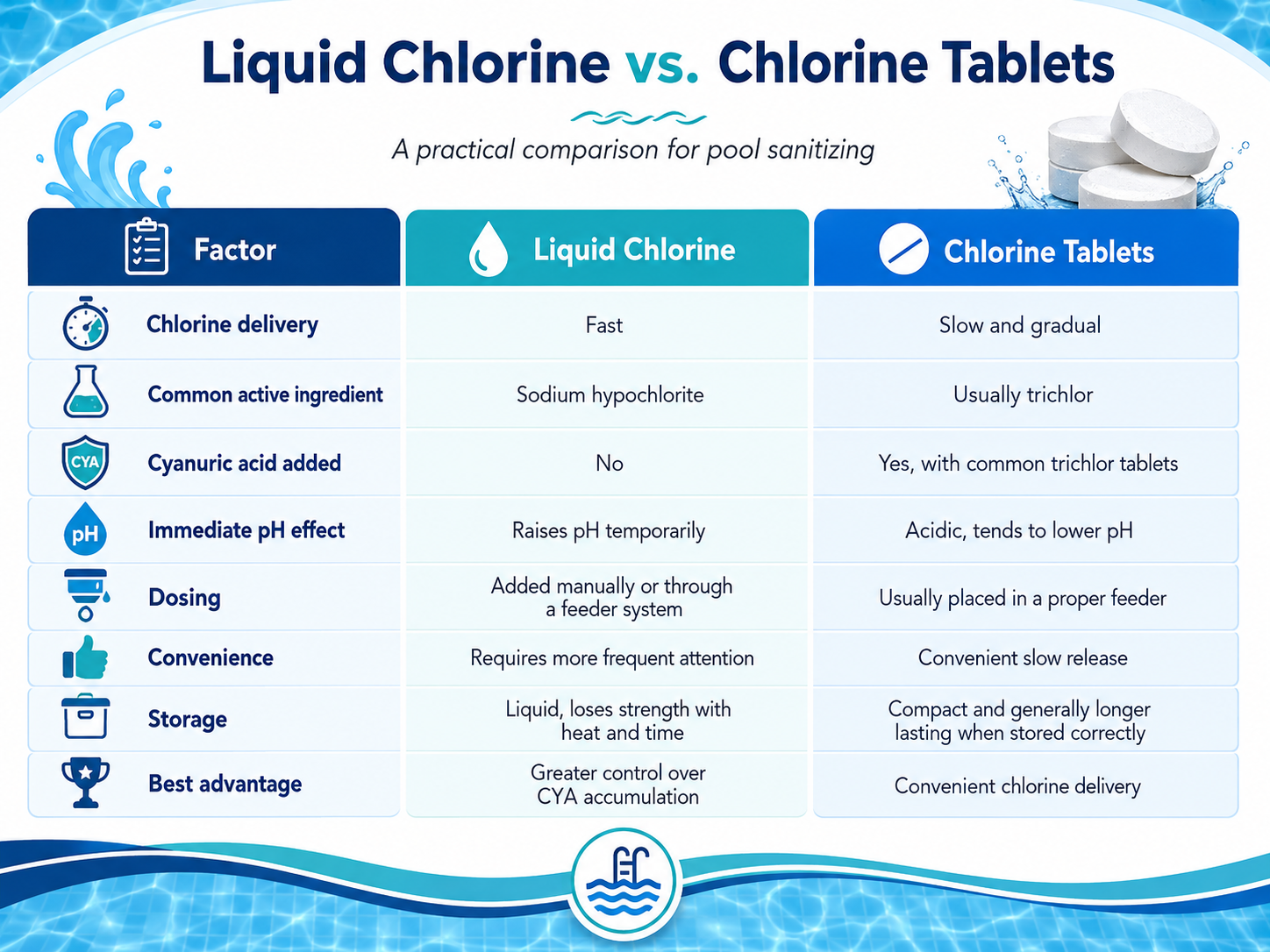
Both products can sanitize swimming pool water when used correctly, but they do not behave the same way. Liquid chlorine provides chlorine without continually adding cyanuric acid, while common stabilized chlorine tablets release chlorine slowly and also add stabilizer. Tablets can be convenient, but repeated use can gradually change the chemistry of the water.
For Dallas and Fort Worth homeowners, hot weather and strong sunlight can make chlorine management especially important. Anomaly Pool Services provides professional weekly pool maintenance in DFW that includes water chemistry testing and balancing alongside routine cleaning.
So, should you use liquid chlorine or tablets? Here is what pool owners should understand before choosing.
The main difference between liquid chlorine and chlorine tablets is not whether they can sanitize a pool. Both can provide chlorine. The difference is what else they add to the water and how quickly chlorine becomes available.
Neither choice eliminates the need to test your pool. Chlorine demand changes with sunlight, temperature, rainfall, swimmer load, debris, algae, and the condition of the water.
Pool liquid chlorine is typically a sodium hypochlorite solution. Once added to pool water, it supplies active chlorine that can sanitize the water and help control microorganisms and algae.
Its major advantage is simplicity from a water chemistry perspective. Liquid chlorine adds chlorine and salt as a byproduct, but it does not continuously increase cyanuric acid.
That makes it useful when the pool already has an appropriate stabilizer level.
Liquid chlorine also disperses relatively quickly with adequate circulation. Pool owners still need to calculate the correct amount based on pool volume, chlorine concentration, current free chlorine, and the desired chlorine level.
If you want a deeper explanation of why this sanitizer is useful, read Anomaly Pool Services' guide to liquid chlorine for pools.
Chlorine tablets, commonly called chlorine tabs or pucks, are concentrated solid sanitizers designed to dissolve gradually.
Many residential pool tablets contain trichlor. Trichlor provides chlorine while also introducing cyanuric acid, or CYA, into the pool. CYA is useful because it protects chlorine from rapid breakdown caused by ultraviolet sunlight.
The problem is accumulation.
Cyanuric acid does not disappear from the pool at the same rate chlorine is consumed. If stabilized tablets become the primary chlorine source for an extended period, CYA can continue rising. As CYA increases, an appropriate free chlorine level must also be maintained relative to that stabilizer level.
Learn more about the role of cyanuric acid in pool chemistry before relying heavily on stabilized chlorine.
For many pools where CYA is already within the desired range, liquid chlorine can offer better control for routine chlorination because it does not keep adding stabilizer.
That does not mean chlorine tablets are inherently bad.
Tablets can be useful when a pool needs slow chlorine delivery and some additional stabilizer. They can also be convenient during certain maintenance situations when used in an appropriate chlorinator or feeder.
The important distinction is whether you are selecting a product because the pool chemistry calls for it or simply adding the same product every week without testing.
At Anomaly Pool Services, chemical care is based on testing rather than assumptions. Its pool chemical balancing service includes testing and adjustment of chlorine, pH, alkalinity, calcium hardness, and cyanuric acid.
If convenience is your main concern, tablets have a clear advantage. They dissolve gradually, so they can reduce the frequency of manual chlorine additions.
However, convenience should not be confused with better chemistry.
For long-term maintenance, tablets may create another variable that needs monitoring because stabilized trichlor adds CYA every time it is used.
Imagine that your stabilizer is already where it should be. Continuing to use trichlor tablets week after week means you are adding something the pool may no longer need.
Liquid chlorine gives you the ability to chlorinate without that continued CYA addition.
So, are chlorine tablets better than liquid chlorine? They can be better for convenience or when additional stabilizer is appropriate. Liquid chlorine can be better when precise control over ongoing CYA accumulation is the priority.
Comparing liquid chlorine vs tabs requires looking beyond the chlorine reading on your test kit.
This is one of its biggest benefits.
Once CYA has reached an appropriate level, you can continue adding liquid chlorine without continually increasing stabilizer.
Common trichlor tablets introduce both chlorine and cyanuric acid.
CYA itself is necessary in outdoor pools because sunlight can rapidly consume unprotected chlorine. The concern is allowing it to become excessive through repeated stabilized chlorine use.
Choosing liquid chlorine does not mean you can add the same amount indefinitely.
A pool may consume more chlorine during:
This is why water testing remains more valuable than following a fixed chemical schedule.
Yes. If you are using common trichlor chlorine tablets, they are acidic and tend to lower the pool's pH and affect total alkalinity over time.
This is important because some pool owners focus exclusively on chlorine while overlooking the balance between chlorine, pH, alkalinity, calcium hardness, and CYA.
When pH becomes too low, water can become more corrosive to certain pool surfaces and equipment. When pH becomes too high, chlorine becomes less effective and scale can become more likely under suitable conditions.
If your readings are moving outside the desired range, review this guide on how to lower pool pH correctly instead of making large chemical adjustments without testing.
This question needs a little more explanation.
Liquid sodium hypochlorite has a high pH, so adding it initially raises pool pH. However, as the chlorine is consumed through the sanitation and oxidation process, much of that initial pH increase is offset.
In real pools, pH can still rise for many other reasons, including aeration and the pool's overall water chemistry.
Therefore, the answer to whether liquid chlorine raises pH is that it produces an initial upward effect, but homeowners should not assume liquid chlorine alone is responsible for every high-pH reading.
Test the water before deciding what needs adjustment.
Your water test results should guide the decision.
If CYA is already at an appropriate level and you need regular chlorine without more stabilizer, liquid chlorine is often the more controllable option.
If CYA is low and you need a convenient, slow-dissolving chlorine source, stabilized tablets may have a place in the maintenance plan.
There is also no rule saying a pool owner must commit permanently to one chlorine type. A well-managed pool may use different products at different times based on current chemistry.
If your water has already turned cloudy or green, switching chlorine products may not solve the underlying issue. Review why a pool can stay green even with high chlorine to understand why chlorine readings alone do not tell the entire story.
There is no responsible universal answer such as "one gallon every three days."
The correct answer to how often to add liquid chlorine to the pool depends on chlorine demand and testing. During warm, sunny conditions, manually chlorinated pools may need liquid chlorine added daily or every few days to maintain an appropriate free chlorine level. Other pools may require a different schedule.
Your dosing frequency depends on:
Testing should determine the dose.
If you do not know your pool volume, use this guide to calculate how many gallons are in your swimming pool before calculating chemical additions.
For routine additions, follow the product label and safe handling instructions. Never mix chlorine products together.
The answer to how often to add chlorine tablets to the pool also depends on testing rather than a fixed number of days.
Tablets dissolve at different rates depending on water flow, water temperature, feeder settings, tablet size, and the pool's chlorine demand.
Instead of automatically filling a chlorinator every week, test free chlorine and CYA regularly and adjust tablet use accordingly.
Also, never throw trichlor tablets directly onto a pool surface. Their concentrated acidic chemistry can damage or discolor certain finishes. Use an appropriate chlorine feeder according to the product and equipment instructions.
For additional safety information, see Anomaly's guide on whether pool chlorine tablets are safe for swimming.
A liquid chlorine vs tablets cost comparison should consider more than the shelf price.
Liquid chlorine may require more frequent purchasing, dosing, and storage. It also gradually loses potency, especially when stored for extended periods or exposed to excessive heat.
Tablets are concentrated, easy to store correctly, and convenient to dose through a feeder. Their higher purchase price can sometimes be balanced by convenience and shelf life.
However, long-term cost also includes the effect on water chemistry.
If excessive stabilized tablet use causes CYA to rise beyond the desired range, correcting the problem may involve replacing a portion of the pool water. That adds water, chemical, and labor costs.
The cheapest sanitizer is therefore not necessarily the product with the lowest price per container. It is the approach that maintains proper sanitation while avoiding unnecessary chemical corrections.
DFW homeowners comparing professional care can also review the guide to pool maintenance costs in DFW.
Dallas and Fort Worth pools experience intense sunlight and high summer temperatures. Those conditions can increase chlorine demand and make consistent testing especially valuable.
A chlorine strategy that worked during mild spring weather may not maintain the same chlorine level during the hottest part of summer.
Likewise, a pool used by two people occasionally has different sanitation demands from a pool hosting frequent gatherings.
Anomaly Pool Services approaches maintenance as a complete system. Its professional pool cleaning and maintenance services combine water care with cleaning and other maintenance needs, depending on the selected service.
This matters because chlorine cannot compensate for every maintenance problem. Poor circulation, a dirty filter, algae growth, incorrect pH, and unbalanced CYA can all contribute to water-quality issues.
Your chlorine routine deserves a closer look if you regularly notice cloudy water, recurring algae, rapidly disappearing chlorine, constantly falling or rising pH, unusually high CYA, or the need to make repeated large chemical corrections.
Cloudiness in particular can have several possible causes beyond chlorine. If visibility has started declining, read about the common causes of cloudy pool water.
If the pool has already developed a significant algae problem, routine maintenance dosing may no longer be enough. Anomaly Pool Services also offers green-to-blue pool cleaning for pools requiring more intensive treatment.
The most important lesson in the chlorine tablets vs liquid chlorine debate is that the sanitizer should match the pool's current chemistry.
Adding tablets because the feeder is empty or pouring in liquid chlorine because the water looks slightly dull is not a substitute for testing.
Professional maintenance can be particularly useful for homeowners who do not want to spend their free time tracking chlorine, CYA, pH, alkalinity, calcium hardness, filtration, and cleaning.
Anomaly Pool Services serves the Dallas and Fort Worth area with ongoing pool care backed by hands-on local service experience. You can learn more about Anomaly Pool Services and the company's approach to residential pool maintenance.
So, is liquid chlorine better than tablets?
For routine chlorination when the pool already has enough cyanuric acid, liquid chlorine offers a major advantage because it provides chlorine without continuously adding more CYA. It also gives pool owners direct control over how much sanitizer they add.
Are chlorine tablets better than liquid chlorine? In situations where convenience, slow chlorine release, and additional stabilizer are useful, tablets can be an effective tool.
The best choice is therefore not based on brand preference or habit. It depends on what the water needs today.
Test free chlorine, pH, alkalinity, CYA, and the other important chemistry parameters. Then select the sanitizer that moves the water toward proper balance without creating another problem.
If maintaining those levels every week sounds like another job you do not need, contact Anomaly Pool Services for professional pool maintenance and chemical care throughout Dallas-Fort Worth.
Liquid chlorine is often a strong choice when your pool already has sufficient cyanuric acid because it adds chlorine without continually increasing CYA. Tablets may be useful when slow chlorine delivery and additional stabilizer are appropriate.
Common trichlor chlorine tablets are acidic and tend to lower pool pH and total alkalinity with continued use. Regular water testing helps identify when adjustment is needed.
Liquid sodium hypochlorite initially raises pH when added. Much of that effect is offset as chlorine performs its work and is consumed, although the pool's overall chemistry can still cause pH to trend upward.
It depends on the pool's chlorine demand. During hot, sunny weather, a manually chlorinated pool may require liquid chlorine daily or every few days. Test free chlorine and CYA and calculate the dose based on your pool volume and product concentration rather than using a fixed schedule.
Add or adjust tablets according to chlorine testing, CYA levels, feeder performance, and the manufacturer's instructions. Do not assume that the feeder should always remain completely full.
A maintenance strategy can use different chlorine sources at different times, but never physically mix chlorine products together. Each product should be handled and applied according to its label. Your choice should be based on current water chemistry.
Stabilized trichlor tablets add cyanuric acid along with chlorine. Repeated use can therefore increase the pool's CYA concentration over time.
Purchase prices vary, so there is no universal winner. Liquid chlorine may require more frequent dosing and loses strength during storage, while tablets offer convenience and concentrated chlorine. Long-term costs should also account for chemical corrections or water replacement if stabilized tablets contribute to excessive CYA.
There is no single product that is right for every DFW pool. Strong sunlight makes adequate CYA useful, but excessive stabilizer can complicate chlorine management. Test the pool first, then choose the chlorine source that fits its current chemistry.
Professional maintenance removes much of the routine testing and adjustment from your schedule. Anomaly Pool Services offers weekly pool maintenance and chemical care for Dallas-Fort Worth homeowners who want consistent, professionally managed pool water.